Fall protection safety nets are essential collective protection equipment wherever a risk of falling exists, from construction sites to residential balconies. In the event of a fall, the safety net must protect the body and absorb the impact.
When this does not happen, the consequences can be severe. For this reason, choosing the material of a safety net is not simply a technical decision. It is a decision that can save lives.
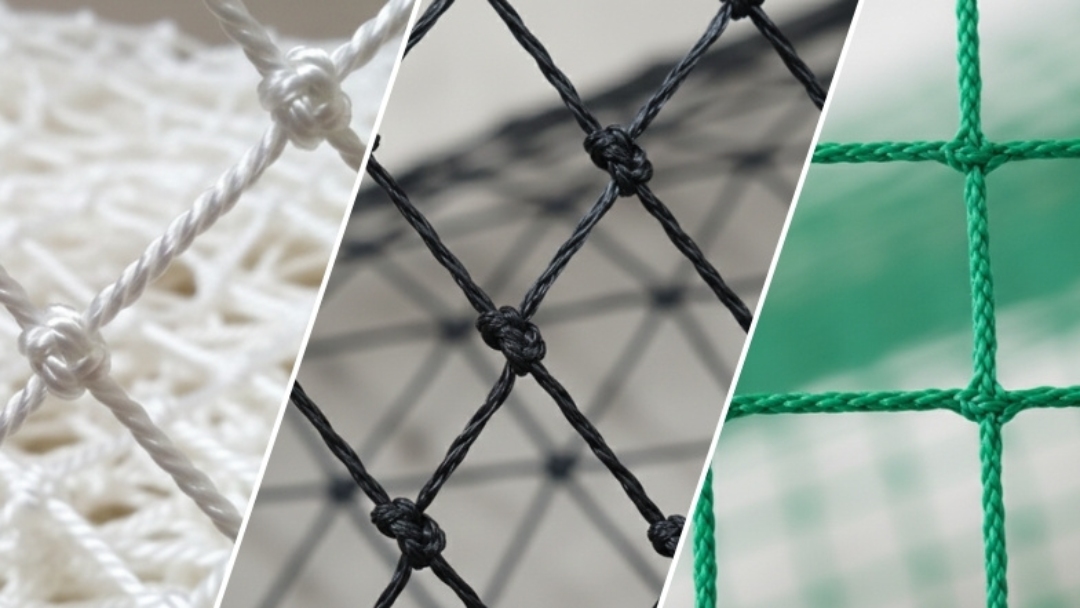
This choice begins with the filament material. Polyamide, polyethylene, and polypropylene are distinct polymers with very different mechanical properties and behaviours. Understanding these differences allows you to select the most appropriate protection net for each application.
This is also where questions often arise. Should you choose the material that seems strongest, the one that lasts longer under sun exposure, or the most economical option? The correct answer requires careful evaluation of the fall risk, environmental conditions, and the safety net’s primary function.
Polyamide (PA): Excellent Impact Absorption Capacity
Polyamide, often known as nylon net, is the reference material for safety nets. It is important to clarify that only polyamide is nylon. Polyethylene and polypropylene are different polymers with distinct behaviours.
How Does a Nylon Safety Net Work?
The main advantage of polyamide lies in its combination of elasticity and strength. This filament allows the net fibres to stretch during a fall, progressively absorbing the impact energy.
In fall protection nets, polyamide is typically used in multifilament structures. This further enhances impact absorption capacity and helps distribute the load across multiple fibres. Even after absorbing an impact, provided there is no structural damage, the material can remain functional.
Applications of Polyamide Safety Nets
These characteristics explain why nylon safety nets are widely used when the primary objective is to cushion the impact of a fall. In practice, this type of net is commonly used in:
- Construction and building rehabilitation projects;
- Work at height with fall risk, such as scaffolding and construction fronts;
- Worker circulation areas with fall hazards;
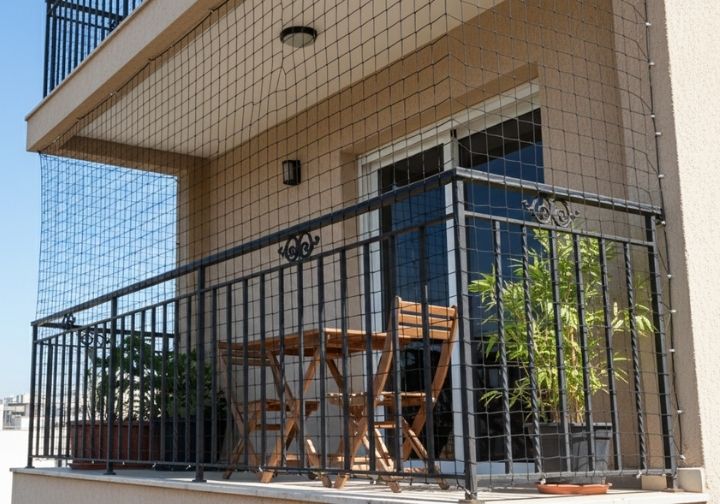
- Protection solutions for openings, balconies, and windows, where there is a risk of falls.
In residential contexts, the safety net’s function remains the same, even though the level of risk differs. For example, balcony nets are often used to protect pets. In these situations, the elasticity of polyamide nets absorbs sudden movements and provides safer everyday protection.

Polyethylene (PE): Dimensional Stability and UV Resistance
Polyethylene is a synthetic material distinct from polyamide. It has a more rigid molecular structure and is naturally more waterproof, giving it greater dimensional stability.
Characteristics of Polyethylene Nets
This material maintains its weight and shape even in humid environments. When combined with UV protection additives, polyethylene nets perform particularly well in permanent outdoor installations, resisting prolonged sun exposure.
However, when used in fall protection systems, polyethylene’s lower elasticity reduces its ability to absorb impact compared to polyamide. In higher-impact scenarios, this characteristic must be carefully considered before selecting the material.
Applications of Polyethylene Safety Nets
For these reasons, polyethylene safety nets are typically used in:
- Perimeter protection for buildings and construction sites;
- Facades and external structures exposed to sunlight;
- Balconies, terraces, and permanent outdoor areas;
- Situations with continuous exposure to harsh weather conditions.
In permanent outdoor environments, polyethylene performs well against weathering and solar exposure. It is an appropriate solution when durability is the priority, and the risk of impact is more controlled.
Polypropylene (PP): Applications with Lower Safety Requirements
Polypropylene is a lightweight synthetic polymer with good chemical resistance and is widely used in industrial applications. However, it presents clear limitations when applied to safety nets, especially in higher-risk contexts.
Compared with polyamide nets, polypropylene has:
- Lower tensile strength;
- Reduced impact absorption capacity;
- Greater sensitivity to UV degradation;
- Lower durability in long-term outdoor applications.
For these reasons, polypropylene is generally used in light protection nets, temporary applications, or situations where the expected impact is limited. It is more commonly found in:
- Temporary protection nets;
- Zone delimitation or light containment;
- Applications where the risk of falling is low;
- Situations where the net is not intended to absorb impact.
Although it may serve a functional purpose in certain situations, it is rarely the best option when human safety is at stake.
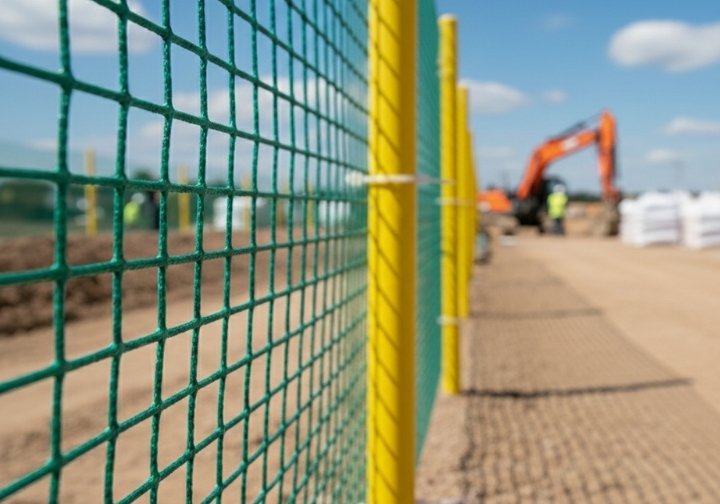
Which Safety Net Is the Best?
To help with your decision, the main differences between the three materials are summarised below. This comparison helps identify which type of safety net is best suited to your situation.
| Characteristics | Polyamide | Polyethylene | Polypropylene |
| Impact absorption | High | Medium | Reduced |
| Elasticity | High | Reduced | Reduced |
| UV resistance | Medium-High | High | Medium-Low |
| Outdoor durability | Medium-High | Excellent | Medium-Low |
| Dimensional stability | Medium-Low | Excellent | Medium-High |
How to Choose the Right Fall Protection Net for Your Project
It is important to emphasise that the performance of a fall protection net does not depend only on the filament material. Factors such as knot type, mesh size, fixing method, anchoring points, and proper installation directly influence how the net behaves. A technically correct net that is poorly installed or used outside the appropriate context may fail at the moment it is most needed.
The comparison between materials is not intended to identify a single winner, but to find the right solution for each situation. Whenever the priority is saving lives by absorbing falls, polyamide stands out. When the focus is on resistance to environmental conditions, dimensional stability, and permanent outdoor applications, polyethylene may be the right choice.
Frequently Asked Questions
Can polyethylene nets be used for fall protection on construction sites?
It is not recommended. Despite its good strength, polyethylene has lower elasticity, which significantly limits its capacity to absorb impact. For life protection on construction sites, polyamide (nylon) safety nets are the technically appropriate choice and are typically required by safety standards.
How often should a fall protection net be replaced?
It depends on the material and level of exposure.
- Polyamide nets used on construction sites should be inspected quarterly and replaced if damage is detected.
- Outdoor polyethylene nets can last several years with proper maintenance. Whenever visible wear, cuts, or loss of elasticity appear, the net should be replaced immediately.
Do safety nets require certification?
Yes. For professional applications, fall protection nets must comply with EN 1263-1 and be certified as conforming. For residential applications, certification is not mandatory but still ensures higher levels of quality and safety.
Evaluating these technical factors allows you to select protection nets adapted to each situation and ensures effective safety. At Cadilhe & Santos, the development of safety nets is based on the real behaviour of materials in use.
If you still have questions about which fall protection net is most suitable for your project, contact our technical team. We help assess your risk scenario and select the safest and most appropriate protection solution.